Asking for Help With Addiction Was the Hardest Decision I Ever Made
The Day I Asked for Help
Asking for help with addiction was the hardest decision I have ever made. On the night of October 15, 2016, I used for the last time.
The truth is, I didn’t know it would be the last time. If I had known what the next few months would bring, I probably wouldn’t have believed it. At that point, addiction had controlled so much of my life that sobriety felt impossible.
As October 15 turned into October 16, I was completely obliterated. Alcohol, drugs, poor decisions, lies, guilt, shame—it had all piled up into one giant mess that I no longer knew how to escape from.
I knew my wife would be coming home soon, and I felt like I only had two options.
The first option was to end everything. I couldn’t imagine facing the disappointment, anger, and hurt that she was about to experience when she discovered what had really been going on. I had already spent years fighting addiction and alcoholism. I had relapsed. Things had spiraled far beyond what anyone around me knew. The full story of how I got to that point can be found on my My Journey page.
The second option was to ask for help.
Locking Myself In
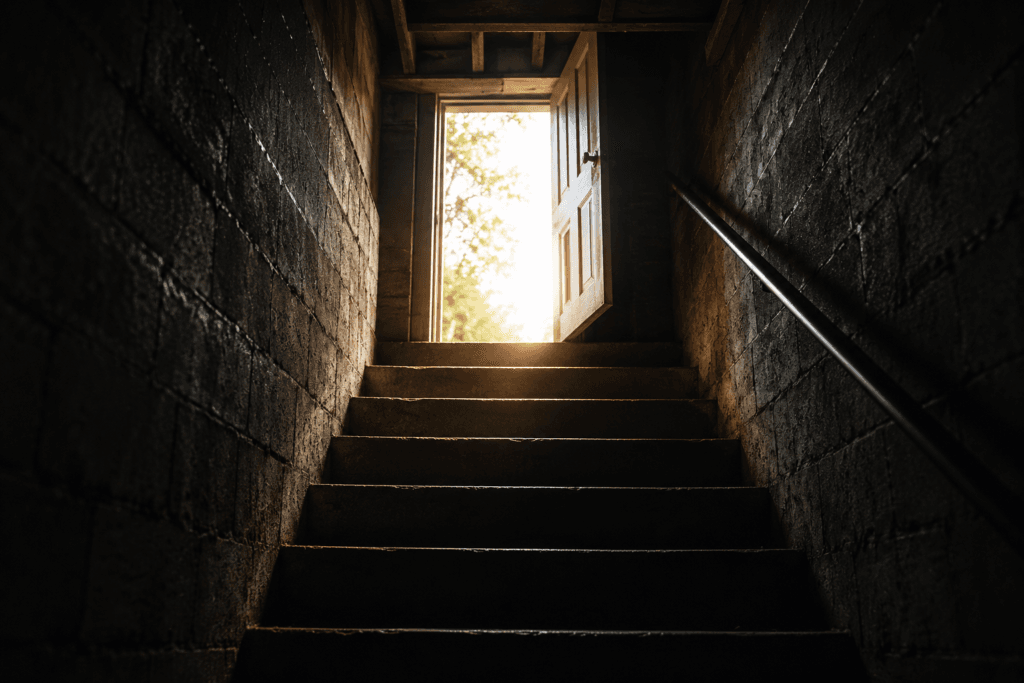
I went downstairs into the basement and locked myself in. I used long screws to secure the basement door shut from the inside. Then I wrote a note explaining where everything was and what had been happening.
I slid the note under the door.
The moment those screws went into the door frame, I knew there was no turning back. I had finally reached the point where I could no longer live the way I had been living.
I needed help.
Around six o’clock that morning, my wife came home.
At first, she looked around the house trying to find me. Eventually, she found the note.
What I expected next was very different from what actually happened.
I expected her to read the note, gather the kids, and leave. In my mind, that was the most likely outcome. I believed I had destroyed everything beyond repair.
Hospital After Hospital
Instead, I listened as she started making phone calls.
Hospital after hospital.
Detox centre after detox centre.
Rehab facility after rehab facility.
Eventually she found a hospital willing to admit me because of concerns about my mental state and the potential risk of self-harm.
I removed the screws from the door and came upstairs.
The next several hours were a blur.
Part of me still wanted to keep drinking. Part of me wanted to run away from the consequences. Part of me knew I had finally hit bottom.
By the evening of October 16, I found myself sitting in a hospital.
I was still a mess.
I was still coming down from everything I had put into my body. I was emotional, angry, sarcastic, and defensive.
Looking back now, the hospital staff were incredible.
At the time, I thought they were judging me.
I thought they didn’t understand.
I thought they were treating me unfairly.
The reality was that they were trying to help someone who didn’t yet know how to accept help.
My attitude didn’t take long to show itself.
A few sarcastic comments turned into more comments, and eventually some things I thought I was saying privately to my wife were overheard through the thin hospital curtains.
Suicide Watch
Before long, I found myself on suicide watch.
That night was one of the longest nights of my life.
My wife stayed by my side while the substances slowly worked their way out of my system. As I became more sober and more rational, the hospital staff eventually removed the suicide watch restrictions.
Then they told me about a place called the Renfrew Detox Centre in Calgary.
At the time, I knew very little about detox programs. I was terrified of what came next and uncertain about whether recovery was even possible. Looking back now, I understand how important places like Renfrew are for people taking those first difficult steps toward sobriety.
If I wanted a chance at getting better, I needed to be there at six o’clock the next morning.
The Renfrew Interview
At Renfrew, admission worked on an interview basis.
You arrived early, sat in a waiting room, and waited for your name to be called. Then you met with counsellors who asked questions about every aspect of your life.
What were you using?
How long had you been using?
Did you work?
What was your home life like?
Had you been through treatment before?
What did recovery look like for you?
The interview felt almost like applying for a job.
The difference was that instead of trying to get hired, you were trying to convince people that you were serious about getting help.
Space was limited.
Not everyone could stay.
I remember being terrified.
My anxiety was through the roof.
My face probably showed every ounce of regret and shame I was carrying.
Fortunately, they accepted me.
Did I Even Belong There?
What I haven’t mentioned yet is how conflicted I felt sitting in that waiting room.
As I looked around, I saw people who looked far worse off than I was. Some looked homeless. Some looked physically broken. Some looked like addiction had completely consumed every part of their lives.
I remember feeling guilty.
Part of me wondered whether I even belonged there.
Part of me wondered if I was taking a bed away from somebody who needed it more than I did.
As strange as it sounds now, I remember thinking that maybe someone else deserved that opportunity more than I did.
Looking back, I can see how distorted my thinking had become.
The day before, I had locked myself in my basement because I couldn’t continue living the way I was living. My addiction had nearly destroyed my marriage, my family, my career, and my future.
Yet I was still convincing myself that maybe I wasn’t bad enough.
That’s what addiction does. It constantly gives you reasons to minimize your own problems, even when your life is falling apart around you.
Entering Detox
For the first time in my life, I entered a detox centre.
Even though addiction had been a part of my life for years, I had always tried to quit on my own.
Like many addicts, I would tell myself that this time would be different.
I would stop.
Then I’d start again.
Then I’d stop.
Then I’d start again.
This time felt different.
I finally understood that I didn’t know how to do it on my own.
The staff at Renfrew were incredible.
The counsellors were supportive.
The volunteers treated people with dignity.
There were resources available, people willing to listen, and a safe place to begin the process of getting sober.
For the first few days, though, I mostly kept to myself.
I’ve never been the most social person, and suddenly I found myself surrounded by strangers who were all fighting their own battles.
Some of those battles were much worse than mine.
I remember one man who arrived several days after I did.
He looked completely emaciated.
At first, he stayed in a separate area of the facility, but eventually he joined the rest of us.
As we talked, I learned that he was heavily addicted to fentanyl.
He hadn’t eaten properly in days.
His addiction had taken nearly everything from him.
It was heartbreaking to see someone in that condition.
It also reminded me that addiction doesn’t care who you are.
It doesn’t care about your plans, your family, your career, or your future.
It only wants more.
Choosing Claresholm
As the detox process started to come to an end, I began looking through pamphlets for treatment programs.
One brochure immediately caught my attention.
Claresholm.
What scared me wasn’t the program itself.
What scared me was the length.
Three months.
Three months away from work.
Three months away from home.
Three months without a paycheque.
I remember thinking, “How is this supposed to work?”
I had a wife.
I had two young children.
I had bills.
How could I possibly disappear for three months?
The counsellors at Renfrew helped calm some of those fears. They explained that there were resources available, including medical EI and social assistance programs designed to help people in situations like mine.
Eventually, I completed another interview.
Again, I answered every question as honestly as I could.
Again, I waited.
Again, I was accepted.
The catch was that I would be going directly from Renfrew to Claresholm.
No going home.
No second guessing.
No backing out.
The plan was simple.
Get on the bus and go.
I spent six days at Renfrew before my wife was allowed to bring me some additional clothes and supplies for treatment.
I was grateful for that small kindness.
Then the day came.
I gathered my belongings, said goodbye to my wife, and got ready to leave for Claresholm.
I had no idea what the next three months would look like.
But for the first time in a very long time, I was moving in the right direction.