I grew up Roman Catholic. I was baptised, had my first communion, first reconciliation, and confirmation. For the most part, I would have considered us a good, upstanding Christian family. We didn’t really go to church all that often. I wouldn’t say my parents were practising Christians, but they believed in God and in the work He did on this planet, or in the universe. Finding faith in recovery was still a long way off.
I went to Catholic school the whole way through, from kindergarten to the end of Grade 8. Then my parents chose not to send me to Catholic high school. The public high school was a little closer, and buying uniforms was compulsory at the Catholic school, which my parents simply couldn’t afford for three kids around the same age. So I went to public school, and I was in for a bit of an awakening.
I started learning things I had never really been exposed to during my years at Catholic school. This was the first time in my life that a few little light bulbs started going off. There was a different world out there, and the world I had grown up being taught about wasn’t necessarily the same world everyone else lived in.
Venturing Out Into That World
It wouldn’t be until my later teenage years, and then into my twenties, that I really started venturing out into that world. My addiction ventured out a lot further too, and continued to get worse. But my inquisitive nature continued to grow as well. I opened myself up to new books, audiobooks, and magazines. When podcasts came around, I put myself in that world too. Over time, I went from what I would have called a Christian, to agnostic, and eventually to an outright atheist.
Ten years ago, when I made that life-changing decision to seek help and treatment, I was what I would call a staunch atheist. If you even brought up religion around me, I would debate you until I was blue in the face about how your entire worldview was completely wrong. And, to be blunt, I probably would have thought you were a complete idiot for believing such nonsense.
I continued to hold that view for quite a long time. Even five years ago, I still looked at the world through an atheistic lens. Everything needed to be examined through science, evidence, and facts. When I got sober and went to Claresholm for treatment, I was still that same staunch atheist. So when Claresholm was presented to me, it was music to my ears. You’re telling me I can go and live somewhere for three months, and the entire programme isn’t based on a 12-step model? It’s based on science. It’s based on facts. Cognitive behavioural therapy. Things that made sense to me and were grounded in evidence. At that point in my life, that was exactly what I needed.
I had no faith or spirituality in my life at that moment. Honestly, I would have told you spirituality was a bunch of nonsense. I had no room in my brain for any type of woo-woo, mysterious garbage. That’s how I looked at it. Period.
An Open Mind I Didn’t Know I Didn’t Have
My eyes would first begin to open while I was actually at Claresholm, on the way to finding faith in recovery. There was another resident at the centre who was a Christian. Now, the treatment centre was constantly encouraging us to be open-minded, and I genuinely thought I was. I thought that was the whole point of the life I lived: to be open-minded, consider the evidence, and be willing to explore new possibilities. That’s how I thought I approached the world.
This other resident asked if I wanted to go to Bible study. It took a bit of pondering, because I wasn’t sure I belonged there. Actually, I was pretty positive I didn’t belong there. But I said yes anyway. I liked this person, and I figured it was all part of the process of opening my mind.
So I went to Bible study, and I was brutally honest with them. I told them I wasn’t a believer. Actually, I tried to be polite. I think I was, although I probably got a little argumentative, questioning their worldviews in what I thought was a polite, maybe even passive-aggressive way. Looking back, it probably wasn’t the best way I could have approached that conversation.
I went back for another Bible study, and this time I kept things a little more low-key. I put myself out there and listened. At the time, I wouldn’t have said either experience changed my mind. If anything, they probably made me dig a little deeper into my atheistic worldview. That wouldn’t change for quite some time. God simply didn’t have a place in my world.
The Feeling I Couldn’t Name
But something started happening, and I don’t know exactly what it was. I don’t know if it was the media I was consuming, the conversations I was having, or simply the passage of time. What I do know is that approximately two or three years ago, I started experiencing this feeling inside me. A feeling of emptiness. A feeling that something was missing. Something I couldn’t quite put my finger on.
When you’re somebody who has spent years living a fact-based, science-based life, and suddenly there’s something going on inside your mind that you can’t explain, you don’t quite know what to do with it. You can’t identify it, you can’t name it, and you can’t necessarily make sense of it. But it’s there. You can feel it.
I knew I had to start exploring it. I had to try to figure out what this feeling was, and honestly, I had no idea where to start.
Well, I shouldn’t say that. I had a slight idea of what this feeling might be, but I wasn’t sure I was ready to reconcile it.
It was that feeling of emptiness. A feeling of wanting to belong. That feeling of something inside you crying out for something more, something you might be missing in your life. And I wasn’t entirely sure I wanted to find out what the answer was.
My Daughter Found It First
As time went on, my daughter actually found faith all by herself. It wasn’t something she had grown up with. To be perfectly honest, she thought I might be mad at her when she told me she had found a church and found Christ on her own.
I got to explain to her that she could never offend me by finding Christ. Even though I would have called myself an atheist, I had always recognized that living a Christian-based lifestyle wasn’t a terrible way to live. The Bible is filled with some lovely concepts and principles for living. You can build a good, fulfilling life around many of the values found in that book.
I continued exploring this feeling I had been experiencing, and eventually, one day, I just told my daughter, “You know what? I’ve got Sunday off. I’m going to go to service with you.”
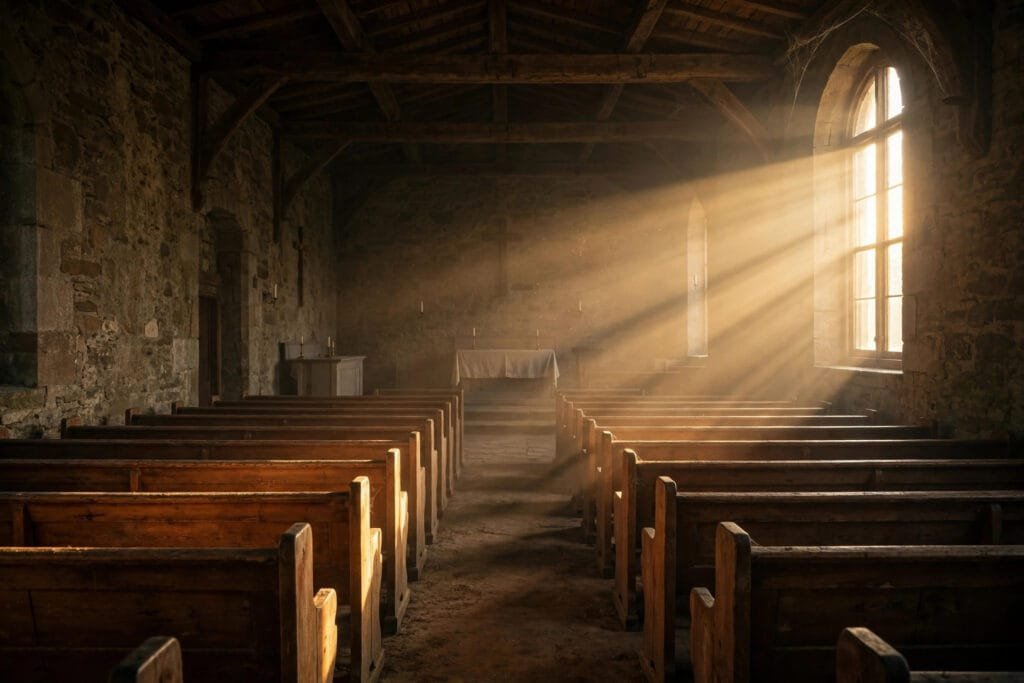
I put on my Sunday best, headed off to Knox Presbyterian Church, and sat in the pew. At first, I felt like an outcast. I felt like I didn’t belong there. I had no idea what I was doing. But at the same time, I knew there was a part of me that needed to be in that pew at that particular moment.
Going to Church With My Daughter
I continued going to church with my daughter, finding faith in recovery as I went, and over time, I built a relationship with the pastor. We started talking more, sometimes going out for coffee and just exploring what was going on in life. Friendships, work, spirituality, and everything in between. It was definitely a slow process.
I started becoming much more open-minded. Slowly, I started putting myself in positions where I could actually listen to the other side. I had thought I was open-minded all those years, but in reality, I had closed myself off from an entire group of people. People who were highly educated, deeply involved in science, and also fundamental believers in Christianity.
Take Francis S. Collins, for example, who wrote the book The Language of God. When I listened to that book, I remember thinking, how is it that somebody who understands the fundamentals of the human genome and has such an extensive scientific background can also be a devout believer in God and Christ?
Here was somebody with an incredible scientific education who wasn’t seeing science and faith as opposing forces. That really got my mind working.
Stories like his, along with the experiences and perspectives of other intellectuals and believers, started challenging some of the assumptions I had carried around for years. I began looking at things differently, and slowly, I started to make a little more sense of that feeling I had been experiencing.
Finding Faith in Recovery: Where Was He? He Was There All Along
Where I once thought there was simply an emptiness inside me, I started to realize there might actually have been something much more meaningful going on. And looking back now, it makes a lot more sense.
I began putting myself in a position where I could look back at everything that had happened in my life and reconsider it through a different lens.
Early in this journey, I probably would have asked myself: “Well, if God was in my life, where was He during this? And Where was He when I was at my lowest points? Where was He when I was struggling, when things were falling apart, and when I needed help the most? Because I certainly wasn’t hearing from Him.”
But over this last year of rediscovering my faith, for lack of a better way of putting it, I’ve started looking back at those moments differently, and finding faith in recovery along the way.
I realized that perhaps God wasn’t absent from my life at all. Perhaps I was simply looking for Him in all the wrong places, or expecting Him to show up in ways I could understand at the time.
When I Look Back
When I look back at my addiction, my recovery, the people who came into my life, the opportunities I was given, and the decisions that eventually brought me to where I am today, I see things differently. I don’t necessarily have an explanation for everything that happened, and I’m certainly not going to pretend I understand God’s plan. But I can look back now and recognize that what I once considered an empty space in my life might not have been empty at all.
God had His finger on the pulse of my life all along. And, as I see it now, He has His finger on the pulse of all our lives.
It still feels somewhat odd to say that, even now. I don’t know why it feels odd, but it does. You spend almost a third of your life rejecting religion and spirituality, convinced that you’ve figured it all out, and then, over the course of a few years, your entire worldview begins to change in a way you never expected.
Ten years ago, if you had told me that this version of myself would be sitting here writing a blog post about God having His finger on the pulse of my life, I would have told you that you’d probably bumped your head somewhere along the way.
But here we are. God has had an impact on my life, and now that I’m looking for it, I see it everywhere.
Whatever Path Works, Work It
Everybody’s journey is going to be different. When I got sober, spirituality wasn’t part of my recovery. It wasn’t at the forefront of my treatment, and it wasn’t something I was looking for. I took a different approach, and it worked for me.
But here I am, almost ten years into sobriety, with a clear mind and a faith that has found its way into my life. Maybe faith found me, or maybe I finally found faith. I think either way works.
There are people whose recovery journey will involve God, the 12 steps, and the use of a higher power to help them overcome their addictions and behaviours. Others might find their way to finding faith in recovery through Buddhism or another spiritual practice. And there are people who will take a science-based approach, just as I did.
Whatever path helps you stay clean, stay serene, and stay sober, keep doing it.
Because what matters most in finding faith in recovery is having a clear mind. It’s being able to make decisions with a sober brain, take responsibility for your actions, and live your life without being controlled by the behaviours that once held you back.
Life Is Never Going to Be Perfect
That’s not to say that once you get rid of alcohol, drugs, pornography, or whatever your problematic behaviour might be, life is suddenly going to be perfect. By no stretch of the imagination is that going to happen. Life is never going to be perfect, because that’s simply not how life works.
But what you do gain is the ability to hold your head up high, knowing that the decisions you make and the actions you take are yours. They’re made with a clear mind, with the best intentions you can manage, and with the ability to take responsibility for the direction your life is heading.
Whether your path to finding faith in recovery runs through God or through science doesn’t matter. There isn’t just one way to get better, and there isn’t just one way to stay better.
If it works, keep doing it.